
Installation
Installation
Stage 3: INSTALLATION
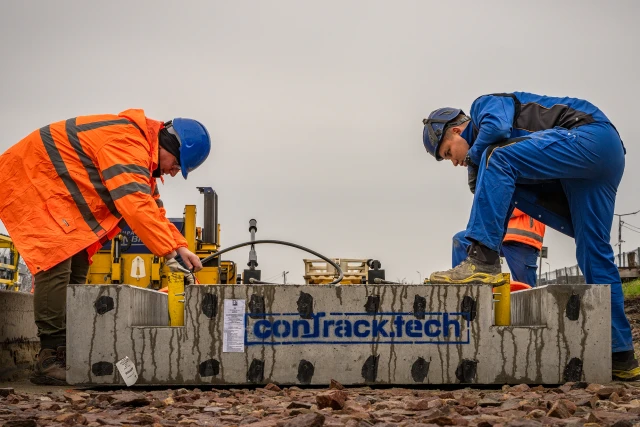
The installation of large-format prefabricated slabs is the stage in which ready-made elements are placed in the excavation and assembled into the final track structure — like a massive puzzle. Thanks to prefabrication, installation works can be carried out in an organized, repeatable, and controlled manner. Moreover, the scope of on-site work is significantly reduced, which shortens installation time and decreases the number of specialists required on site.
Watch a short report from this stage:
PLACEMENT AND ADJUSTMENT
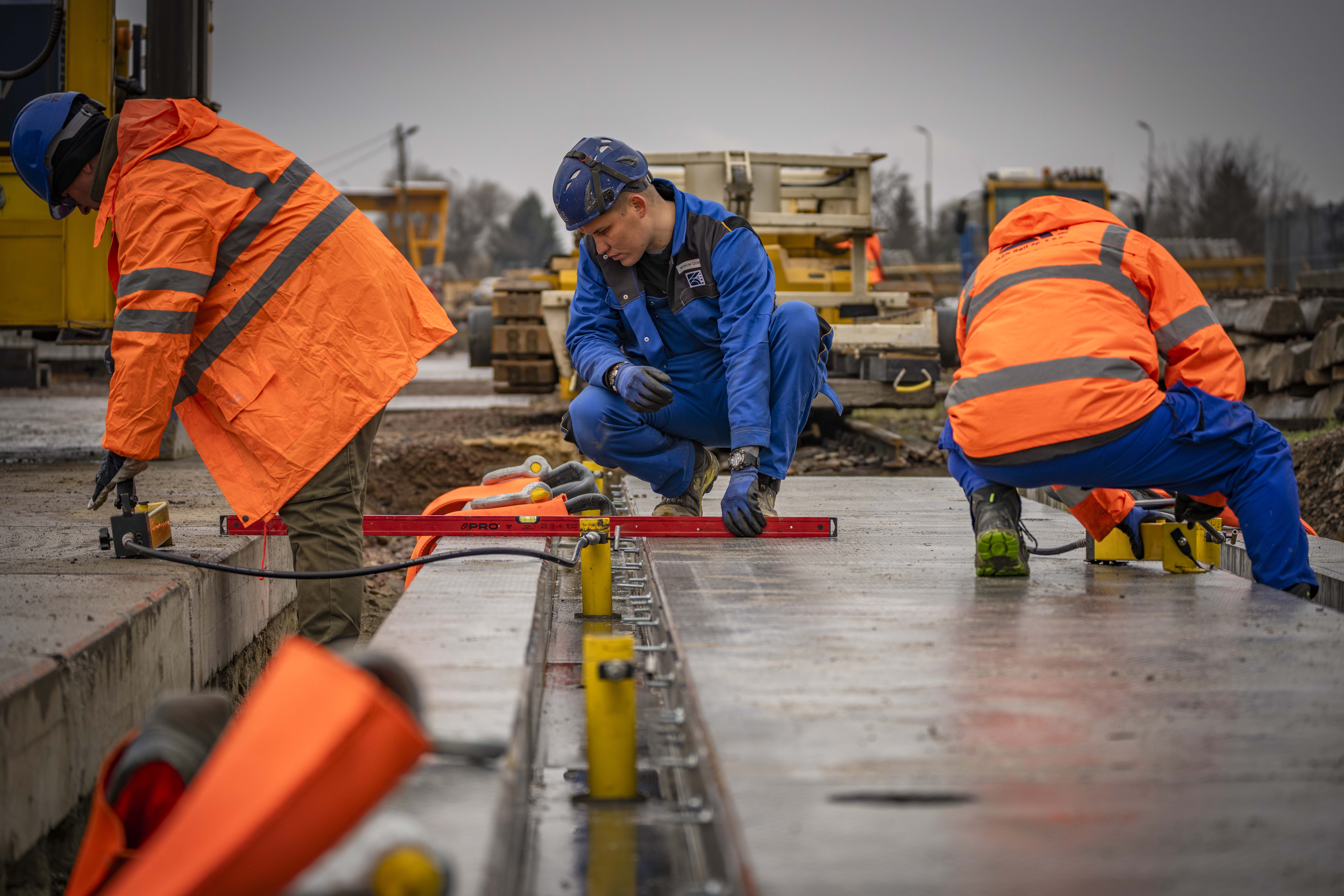
Prefabricated slabs are installed on a prepared base using systems that enable precise positioning. The installation process includes adjusting the position of elements both in terms of vertical alignment (elevation) and their placement within the track layout.
The system includes solutions enabling both vertical and horizontal adjustment, in particular:
- lateral adjustment systems using steel assembly components;
- central adjustment systems using hydraulic actuators installed within the rail channels.
The choice of adjustment method depends on installation conditions and the accessibility of slab edges. For slabs with accessible edges, lateral adjustment is used, whereas in closed configurations — where the slab is surrounded by other elements — a central adjustment system is applied.
The adjustment process continues until the required track geometry is achieved, after which grouting is carried out to stabilize and permanently bond the structure with the subbase. The adjustment components serve a temporary function and are removed once the process is completed.
GROUTING AND FILLING MATERIAL
Grouting is a layer of binding material applied by injection into the space between the prefabricated slab and the subbase. Its purpose is to ensure full, uniform support of the element and its integration with the foundation.
In CONTRACK technology, a fast-setting and self-leveling material is used, which is introduced under all elements of the system in a controlled manner. The grouting process is carried out simultaneously in sections — for several or a dozen slabs — allowing for the creation of a uniform, continuous structure.
The filling material is used to fill technological spaces such as rail chambers and expansion joints.
In rail chambers, the filling material ensures proper embedding of the rail, enables its cooperation with the track structure, and dampens dynamic impacts.
In expansion joints, it allows for compensation of deformations resulting from structural behavior and applied loads, while ensuring system tightness.
The filling material also performs protective functions — preventing water and contaminants from penetrating the structure and reducing the risk of degradation of track components.
FINAL RESULT
The result of the installation process is a sealed, monolithic track structure in which prefabricated elements work together as a single system.
The resulting structure is characterized by:
- no water infiltration beneath the slab;
- reduced risk of subbase washout and degradation;
- elimination of negative effects of freeze–thaw cycles;
- increased system mass, positively influencing mechanical performance;
- high durability and stable operational parameters throughout the entire life cycle.
The CONTRACK monolith is not merely a construction outcome, but the result of a comprehensive approach to track system design and execution, where tightness, structural integrity, and long-term durability are key.