
Logistic
Logistic
Stage 2: LOGISTICS
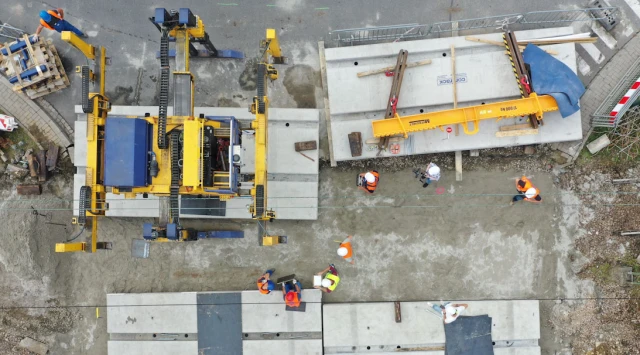
CONTRACK technology logistics includes planning and executing the transport of prefabricated elements in synchronization with the project schedule. This ensures that deliveries are carried out in an organized manner, reducing downtime and facilitating work organization.
It is an integral part of the CONTRACK system, streamlining the entire process and enabling operations in a just-in-time model. Combined with a well-planned installation phase (work schedule), it allows for rapid-track reconstruction — a system that significantly shortens project execution time.
This stage includes both internal logistics, delivery to the construction site, and the placement of prefabricated elements at their installation location.
Internal Logistics
In internal logistics processes, we use our own machinery operating within our assembly yard. As part of double quality control, each set of large-format prefabricated elements undergoes trial assembly. For this stage, as well as for loading and unloading slabs, we use, among others:
- a large-scale three-wheeled gantry crane
- PWP gantry systems
- cranes
Delivery to the Construction Site
Large-format, heavy-weight CONTRACK prefabricated elements are delivered to the project site either by road or rail.
Road transport is our standard delivery model. It enables the delivery of large-format prefabricated concrete slabs directly from the factory to the construction site in accordance with a pre-planned schedule. Loads up to 3.2 m in width, 13.6 m in length, and not exceeding 24 tonnes can be transported without escort. All larger indivisible elements exceeding these parameters are treated as oversized transport, up to a maximum width of 4.5 m, with specially planned transport routes.
Rail transport is always preceded by an individual analysis of route constraints. It may involve several or even dozens of platforms, whose load capacity is approximately twice that of a standard road transport unit.
On-Site Logistics
Construction site logistics are always planned individually, depending on the scope of work, to ensure the fastest and most precise installation while fully utilizing the potential of CONTRACK technology. Consideration is given not only to the size of prefabricated elements but also to the specific characteristics of the location and installation conditions.
In addition to standard solutions, we use tools such as:
- ORMIG 55T indoor crane, designed for operation in confined spaces, with a lifting capacity of up to 60 tonnes;
- MAN/Effer 2750 3S truck-mounted crane (HDS) with a lifting capacity of up to 32 tonnes;
- a dedicated PWP gantry system, enabling work under overhead traction lines within a limited working area;
- a self-propelled industrial crane with a lifting capacity of 100 tonnes.
In cases of localized replacement of specific infrastructure elements (such as turnout systems or crossings), prefabricated elements can be installed under suspended traction wires with the power switched off — eliminating the need for their dismantling, saving time and reducing costs. In such scenarios, PWP gantry systems are particularly effective, as they can unload prefabricated elements directly from trucks. They enable longitudinal transport (even over several kilometers) as well as lateral movement (up to several meters), allowing them to enter the installation area and precisely position the prefabricated elements.
Key Parameters
Working load of a single PWP gantry
Working load of two gantries
Maximum gantry height:
Maximum lifting height (from the ground to the bottom of the sleeper when lifting a 60E1 turnout block)
Standard railway overhead line height