
Production
Production
Stage 1: PRODUCTION
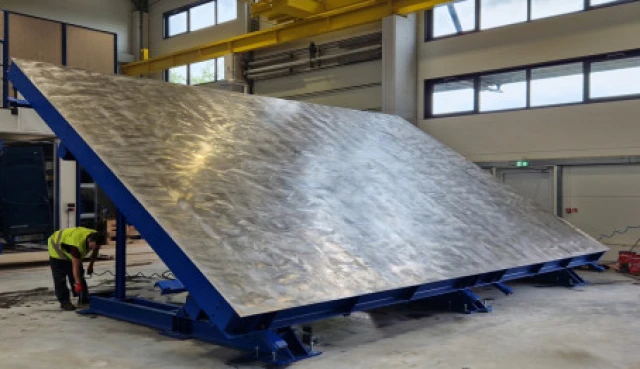
Production includes the preparation, design, and prefabrication of infrastructure elements in a controlled factory environment, off-site.
The entire stage is subject to strict technological supervision. Large-format prefabricated concrete slabs are produced as ready-made elements, precisely tailored to the geometric specifics of a given track layout and the client’s requirements. This eliminates the impact of external conditions and ensures consistent, high initial quality.
Thanks to our in-house technological facilities, we can provide customized design and production of prefabricated elements, going beyond our standard rail and road product offering.
What does the prefabrication stage in CONTRACK technology look like?
1. Preparation
At the preparation stage, all technical parameters of the elements are precisely defined: slab dimensions and weight, types of reinforcement, surface texture, and geometry (including cant and curves). The range of possible solutions is determined based on applicable guidelines.
At the same time, design documentation and interdisciplinary data are analyzed, enabling the identification of potential conflicts and addressing them already at the design stage.
2. Design
Based on the adopted assumptions, detailed design documentation for the prefabricated elements is developed, taking into account all technical, structural, and interdisciplinary requirements. At this stage, solutions are refined, including the layout of reinforcement, technological openings, and lifting systems.
For tram and railway infrastructure, the prefabrication documentation is always aligned with the steel track design, ensuring system consistency and proper interaction between all structural components.
The design process concludes with verification and approval by the client, which forms the basis for starting the prefabrication stage.
3. Slab Prefabrication and Turnout Production (or other steel components, if applicable)
Once the documentation is approved, the prefabrication process begins. Prepared reinforcement is placed on production tables, where the concrete part of the element is produced in accordance with the design and technological standards.
During production, all required openings, ducts, and elements resulting from interdisciplinary coordination are executed.
Precision and Repeatability
The production process, supported by advanced technological supervision and close design cooperation, enables precise replication of the geometry of rail-road systems or any specialized surface (such as bus bays or industrial floors).
Integration of structural components (large-format reinforced concrete slabs and the steel structure) can take place either during prefabrication or directly on site. As a result, ready-made modules are delivered to the construction site, allowing for efficient assembly — almost like fitting together prefabricated blocks or puzzle pieces.
This approach simplifies the installation process, significantly accelerates it, reduces the risk of execution errors, and minimizes the number of personnel required for assembling key infrastructure components.
REINFORCEMENT TYPES
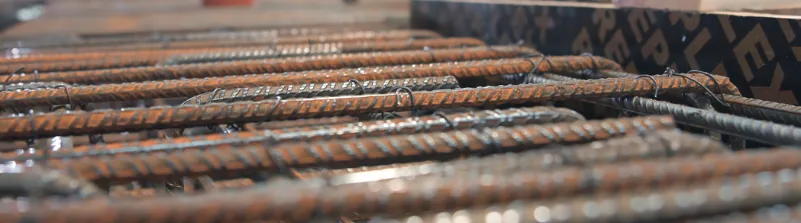
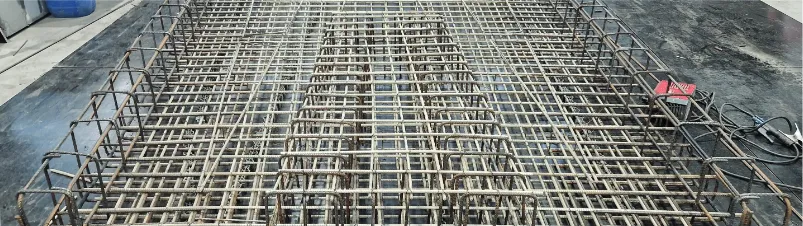
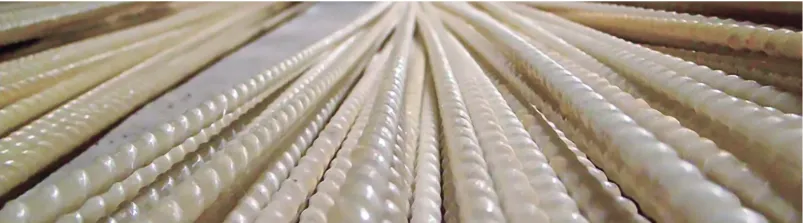
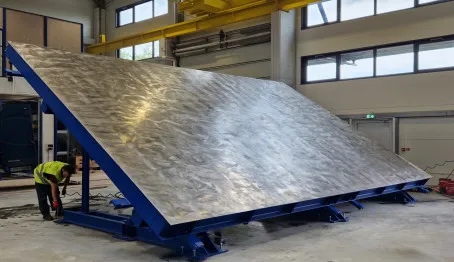
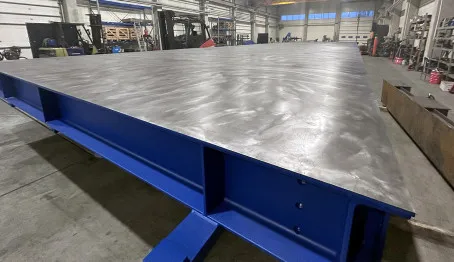
We operate two vibration tables that enable the production of large-format prefabricated concrete slabs: one measuring 5 × 8 m and another 4.5 × 18 m. This allows us to manufacture prefabricated elements up to 17 m in length (for example, large-format tram or railway crossing slabs).
MAXIMUM DIMENSIONS OF PREFABRICATED SLABS
| Thickness | Width | Length | Weight | |
|---|---|---|---|---|
For traditional, composite, and hybrid reinforcement slabs. | 0,4m | 4,5m | 7,5m | 19t |
For traditional, composite, hybrid, and prestressed reinforcement slabs. | 0,4m | 4m | 16,5m | 38t |