
News
Prefabricated turnout slabs for the UJ junction are ready
The Straszewskiego-Piłsudskiego street in Krakow will be renovated using, among other things, CONTRACK technology. Prefabrication of key elements of the tram turnout system is intended to reduce workload and shorten standard construction times. The manufacturer has already completed production of the large-scale prefabricated elements – they will be assembled at their final location like giant puzzle pieces.
- CONTRACK technology will be used to reconstruct Straszewskiego Street from Smoleńsk Street to Piłsudskiego Street and Piłsudskiego Street on the section from Straszewskiego Street in Krakow (UJ/AST)
- KZN Contrack is a manufacturer of precast concrete tram turnout components—large-scale slabs that will be used for installation. The company is part of the KZN Bieżanów Group.
- The manufacturer of the steel part of the turnouts is Kolejowe Zakłady Nawierzchniowe "Bieżanów" - the parent company of the KZN Bieżanów Group
- The contractor of the works and the recipient of the prefabricated elements is a consortium of companies: SPAW-TOR Sp. z o. o. (leader) and PROGREG BUDOWNICTWO Sp. z o. o. (partner)
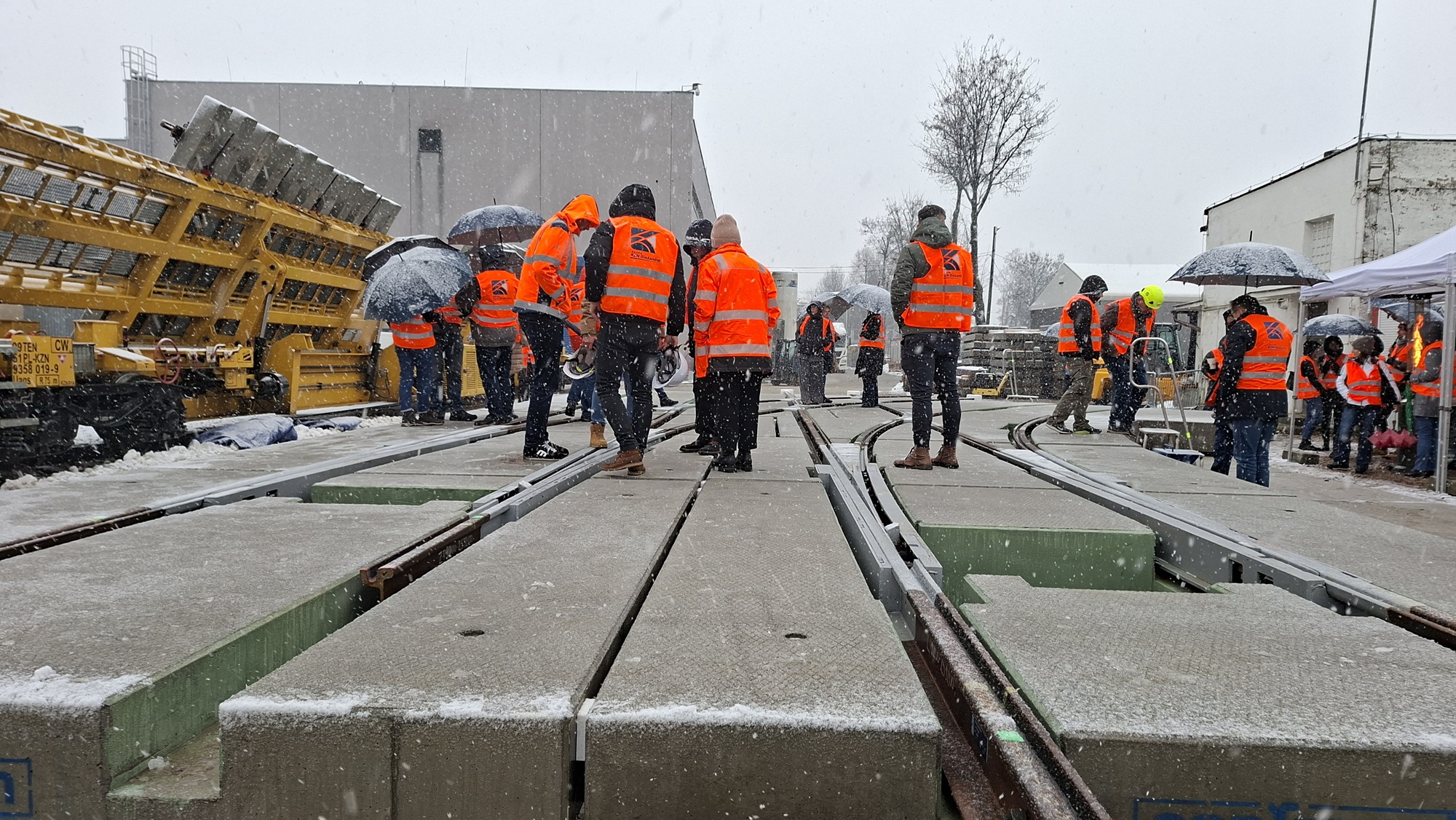
To date, CONTRACK technology has been used in cities such as Poznań, Bytom, Mysłowice, Ruda Śląska, and Warsaw (Zawiszy Square – the entire turnout system, including 121 large-size CONTRACK slabs installed in 5 weeks). Krakow has previously used the technology to renovate the tram crossing on Telimeny Street. However, the UJ junction marks the first such extensive use of the technology in this city – as many as 52 large-size precast CONTRACK reinforced concrete turnout slabs will be installed here , with a total area of approximately 660 m². Approximately 237 m³ of concrete was used to construct them, and the largest slab weighs 21.8 tons . This will complete the entire track triangle, consisting of three single-track double-track turnouts, 11 of which were constructed with hybrid reinforcement.
The prefabricated tram elements will be collected and installed by the modernization contractor – SPAW-TOR.
Why CONTRACK technology?
Previous tram turnout construction technology required multiple layers of concrete to be poured directly on site, with a setting time of 28 days (concrete curing). CONTRACK panels undergo this process at the manufacturer's facility and are delivered ready for installation.
Manufacturing the pavement in a strictly controlled factory environment, independent of external factors, allows for much greater precision and initial product quality , which translates into increased durability . Combined with the highest assembly standards, the result is a complete junction that is perfectly integrated with the roadway and designed for long-term use.
During the construction phase, this technology saves time, which is essential when pouring concrete "wet," but the key savings become apparent during the life of the precast element. The durability of the concrete structure is three times greater than that of a steel turnout structure. CONTRACK allows for steel replacement without damaging the concrete surface . This means that up to three turnouts can be installed during the life of the precast element, without the need for each dismantling and construction of the concrete surface.
A significant advantage of CONTRACK prefabrication is the standardization of construction technologies used – both for straight sections of track and for turnout junctions. This allows us to apply the same construction and maintenance processes across very long sections. This has a positive impact on the organization and duration of work, reducing problematic construction and operational interfaces between different technologies, and consequently, reducing the associated costs.
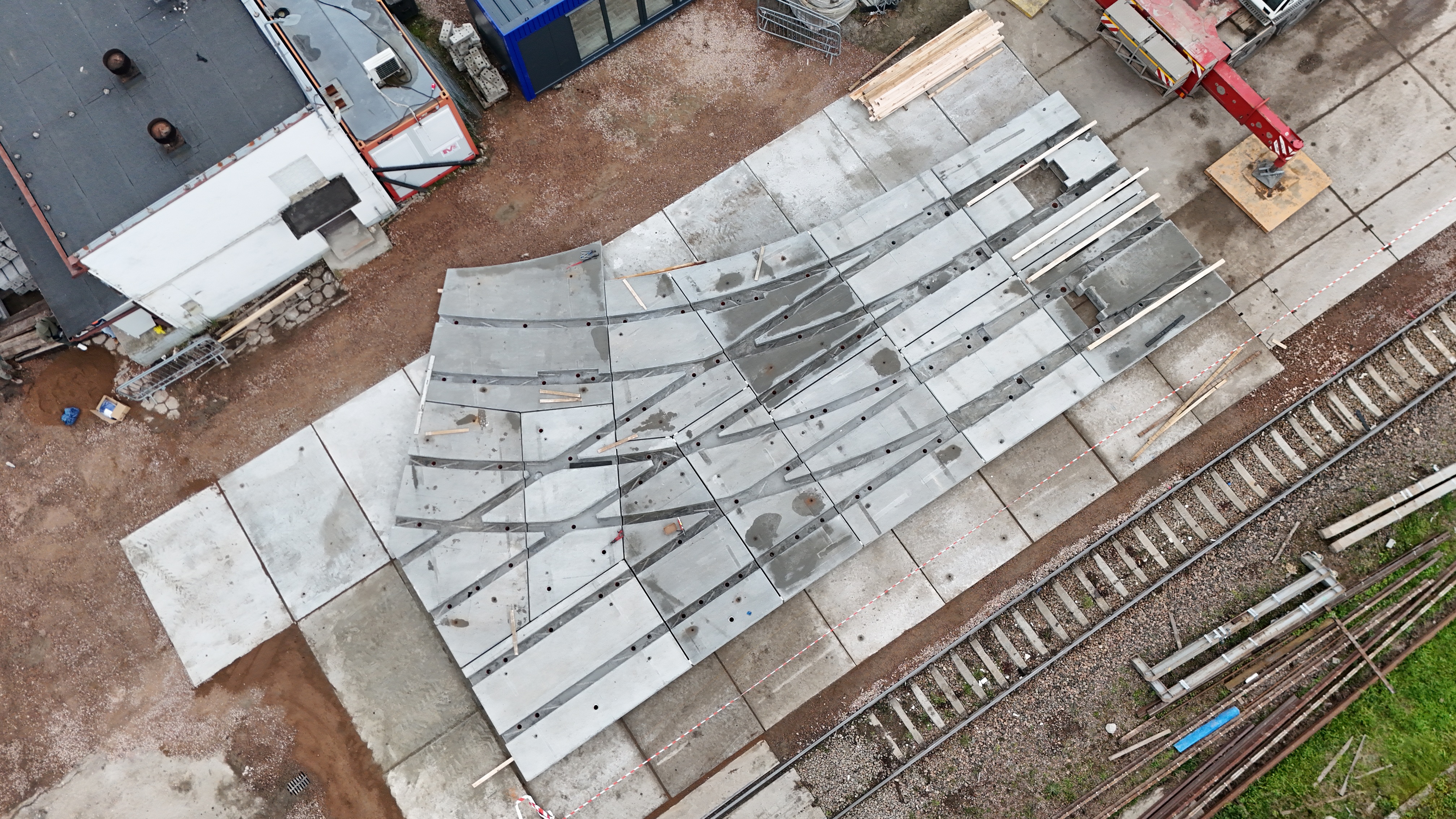
Double quality control – trial layout of the system at the assembly site
CONTRACK panels are each designed for a specific turnout, crossing, or—as in the case of a turnout system conversion to UJ/AST—an entire turnout node. There are no ready-made, mass-produced solutions. To meet the highest standards, ensure the best possible initial quality, and ensure the longest possible panel life, CONTRACK employs double quality control.
The first phase of quality control is performed immediately after production is completed – the geometry of each individual slab is carefully checked. The second phase of quality control was observed at the CONTRACK yard – all slabs from a given construction stage (in this case, a stage consisting of 13 slabs was presented) are trial-laid and fitted together with the steel turnout components . This ensures the manufacturer's accuracy and allows the contractor to smoothly complete the work on the final construction site.
UJ/AST Junction – What's Next?
Using CONTRACK technology to modernize the UJ/AST interchange in Krakow – the city where the technology originated – is a step toward a modern approach to repairing key infrastructure and an opportunity to reduce the social costs of repairs borne by residents. It is precisely in locations as crucial for tram and car transport as the UJ interchange that CONTRACK technology can prove its best performance – it offers the opportunity to extend the life of the surface, reduce the time required for future repairs (the steel section can be replaced), and, under the right conditions, accelerate the completion of work.
Similar posts